News and Events

Keep up to date with Steve Nurse's designs and 3d printing.

Tuesday, 11 October 2022

Design Fringe Setup and Opening

 Hi

This post has a bit of overlap with my bikes blog but anyway I will post it here - anyway, be prepared for photos of busted bike bits!

For several years I have entered Fringe Furniture, a local open entry design competition and exhibition.  Its been quite fun. If I am an artist, I am a very shy one, and don't actively go out and sell my art. 

Fringe Furniture and its successor, Design Fringe have been a bit of an exception, and I've gone out for several years and put things I've made on show and (hopefully) make an impression and (hopefully) sell, but if they don't, I'm not that fussed and am quite happy to schmooze and mingle with other artists and just hang out and enjoy myself. One mob I met was the Space Tank Studio, and I have used the routing mob who were based there (Sean and Horn) several times.

Anyway, after several years of the exhibition running locally at the Abbotsford convent, covid came along, and the exhibition went virtual for a few years, and though I entered, nothing much happened, although I did get some online exposure through Designers on Your Doorstep, a Linden new art initiative. 

Bike in original form - you


can't steer or ride the bike

when its broken like this.


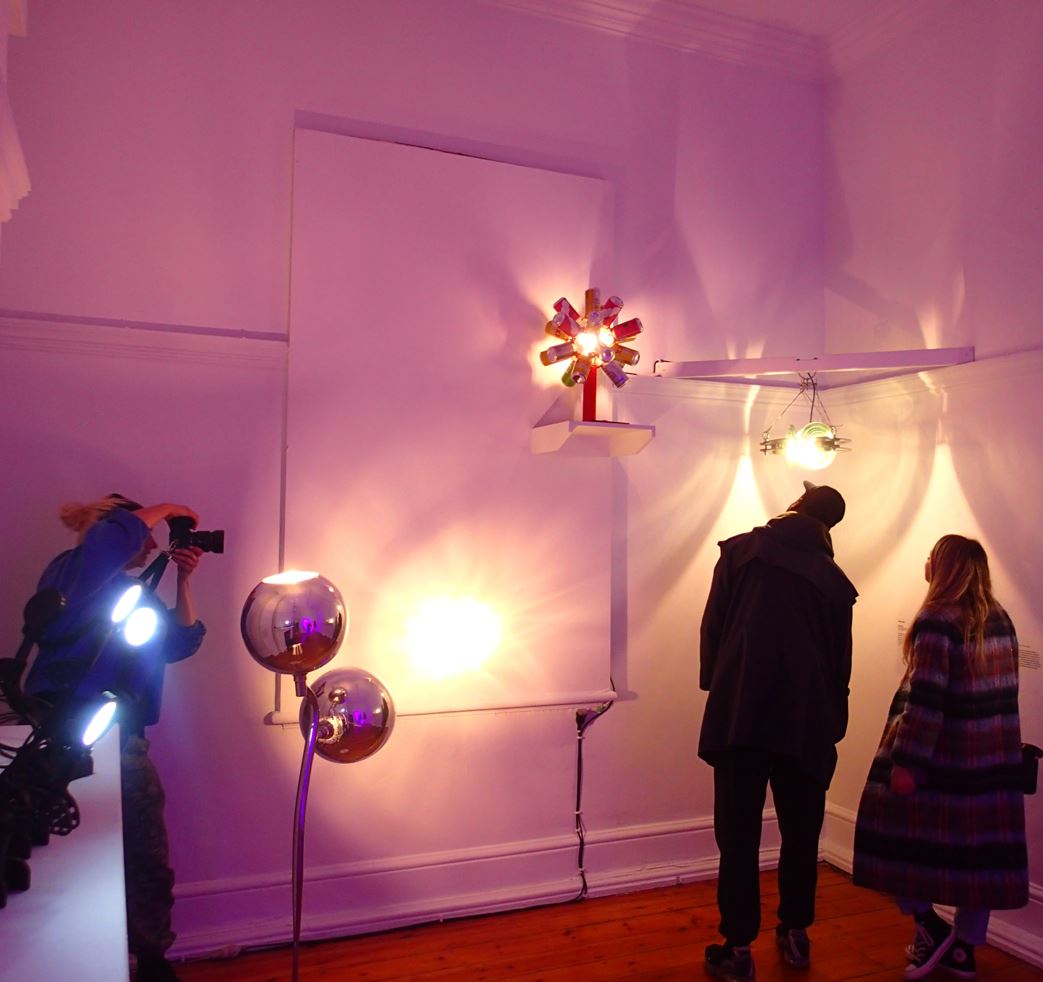
This year I made another lamp for Design Fringe and installing it wasn't easy. Somewhat stubbornly, I decided to ride down to Linden in Acland St St Kilda. Unfortunately, I was a day early and also my bike broke on the way there. The steering had been wonky and eventually just as I hit the foreshore it broke, depositing me and the bike and my assembly of beer cans (ok, lampshade) on the tarmac. It was unrideable!

 As well as installing at Linden, I had planned to visit my Dad in hospital so I had a bit of a rethink about what to do and loaded stuff in the bike again and walked on the 3 or 4 k from Port Melbourne to St Kilda, passing the big Paul Kelly mural on the Espy Hotel on the way.

It turns out I was a day early for bump in but was greeted warmly by Juliette anyway. The lampshade bits were damaged, and I couldn't ride the bike, so I asked Juliette if I could leave them there till the next day, and she kindly agreed. So I walked to the tram, then swapped over to the train in the city and was home fairly quick. I rang my Dad, explained the problem and he was ok with that.


In the afternoon, I stole some steerer bits off other bikes, so I could fix the bike next day. As well I stuck 3d printed stuff to beer cans to make up for the lampshade parts I'd broken.  Early the next day, I headed back down to Linden and quite enjoyed the tram ride this time, it is the 96 and runs through Albert Park on a former railway line. 

This time things went ok, I had enough cans and joiners and bicycle spoke parts to fix the lamp, and fixing the bike went ok too, except I didn't fix the gearing and rode home the whole way in highest gear which wasn't too bad.

Wet!  But no parking problems on opening day.


The next major event in Design Fringe was opening day. I was at the Wecycle bike shed helping out in the morning and left at about 1 for the 2pm opening. Unfortunately it was very rainy, and I pulled over to shelter under a Docklands highrise about halfway there. The rain let up after a while, and the rest of the trip to St Kilda wasn't too wet. But I did arrive at Linden a bit late, a bit wet, a bit bedraggled, and a bit dispirited. 


The opening speeches bit was underway, and it was reasonably crowded, so I squeezed in, grabbed some food and a beer and was eventually rewarded by hearing my name read out as Honourable Mention in the Banyule Council Design for a Circular Economy Award. Now as far as awards go this is not the greatest, the reward for winning it being precisely nothing, and rating below the Archibald, the Booker, the Miles Franklin. But I was quite happy to take it, an eventual pay off for years of entries. I rang my wife Christine at home, she was very pleased for me.


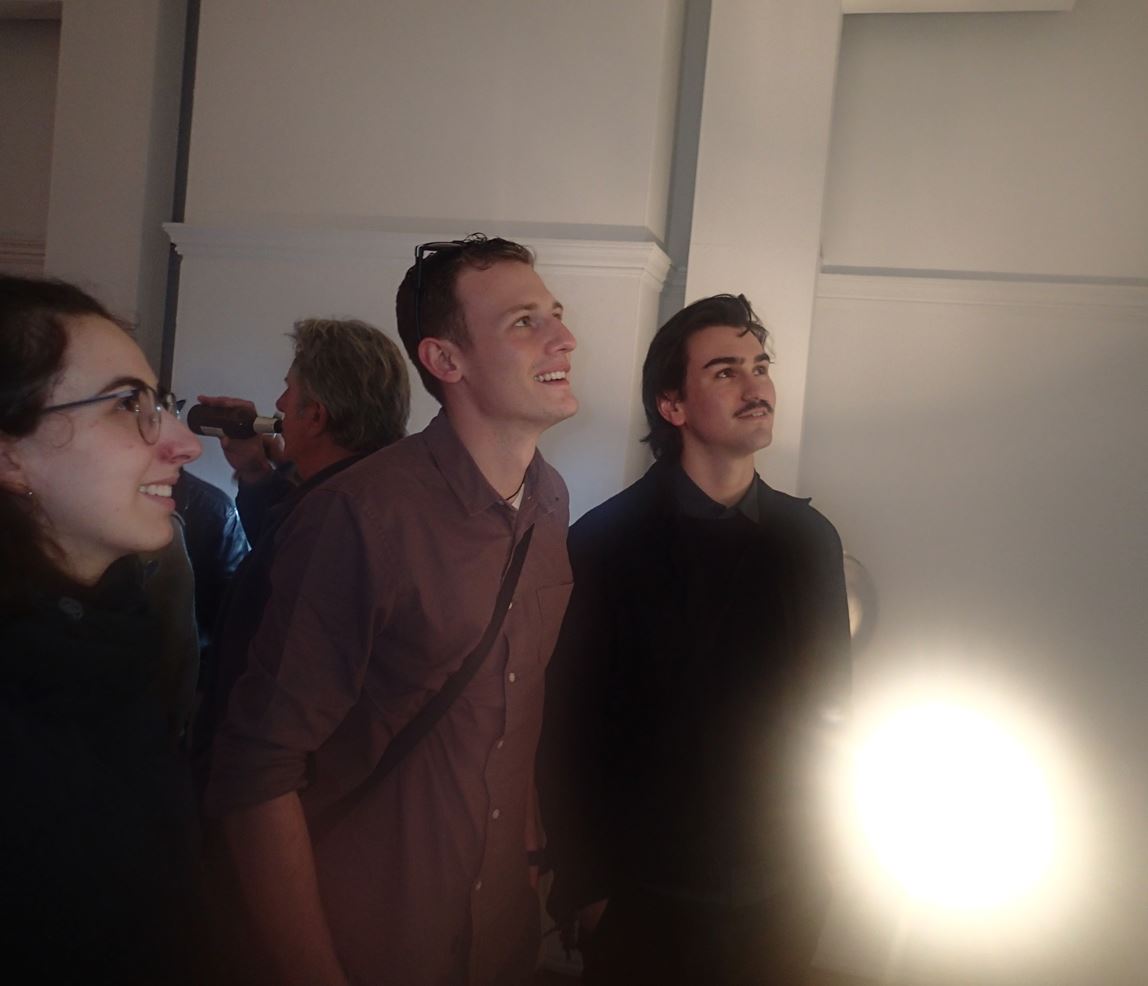
After a look around the entries, I found out where mine was, and went in to check it out. There were a few other artists there including Kaspian Kan, Kenton Rogers, Thomas Vasquez-Lee and Edward Linacre, so I was able to chat and discuss our works.  


A few hours later and the crowd was thinning out but I had to wolf down quite a bit of the dips and bread just to generate a bit of body warmth and have enough energy to ride home. It had been a good day and the weather had decided to be nice to me!

For a few months now, I have been writing an article explaining the techniques behind my Fringe lamp constructions (cds were used for Designers on Your Doorstep last year, and drink cans for this year's entry) for the Australian Maths Education Journal. Its all written and finalised, and seeing as it forms a sort of exigesis for the work, I dropped a copy off at Linden New Art a few days later, visited the Design Fringe's second exhibition space as well.


Before it was a lamp, this year's lampshade was a raft, and I made a couple of videos of it here and here. It floats and tumbles!

Thanks to Juliette and Linden New Art for organising the opening and exhibition. The full Australian Maths Education Journal should be available online soon, after its been published in the Journal.

Wednesday, 10 August 2022

A Few faves

 Hi

Recently I entered Design Fringe for the fourth or fifth time and went through the slightly complex process of entry, which included questions about my favourite designs and designers.  I didn't really think too hard and just put down a few of the first and most current things I'd thought of. So most of this post was mentioned in my Linden New Art Design Fringe Entry form, except for the pipe cutter, that is a ring-in, but I had discussed it with a colleague at work a few days ago.

PIPE CUTTER

About 15 years ago, I bought this in a market in Cabulture, Queensland, while on holiday and bought it back with me. Its lived in my shed ever since, and is the heaviest pipe cutter I have ever seen. Its from the 1960's / 1970's Australian Ford / Holden / Valiant school of engineering, ie strong, not much engineering, lots of weight. It works well but is possibly too heavy.

STICKY TAPE DISPENSER


This was found in a drawer in our house, and I have no idea where it originally came from, but its nice and simple, was made in Australia has nice symmetry and is different to every other tape dispenser I've seen.

BRIAN SADGROVE


Brian Sadgrove was a designer for Sun Books, and for a long time Sun Books' subjects and covers have appealed to me, especially covers by Brian Sadgrove. So I've bought a lot of Sun Books from op shops for not very much and will buy almost anything irrespective of quality. A few of Brian's covers from books I own are shown above. After handling these I ran away to some op shops and free book stalls to try to find more, without luck this time.

VI VUONG


 Vi has made many many bikes, and shares their designs on youtube. I've taken his design, the "Ilean trike" or simple leaning trike a bit further than he has. Vi has been a great inspiration.


Friday, 8 July 2022

Some models in context: skeleton octahedron etc.


Hi

A few weeks ago our friend Chris came over and introduced me to a type of cube, which I made a paper model of (fig 4 here ) After making a few different versions and variations of it, I realised some of the characteristics of the polyhedra that were being made:

* Models made from paper or flexible cane can represent the platonic solids. A basic version of these particular models have a ring around the outside of a face as the best representation of that face, like pictures at the bottom of the page here.

* These models have corners consisting of overlapping edge elements, and two canes or paper elements as edges.

* Because edges consist of 2 canes or strands joining each node, each node is "even", so by definition the network has 2 or no odd nodes, which is the condition for traversability. As well the network (no odd nodes) can make a Euler Circuit. Forming single circuits requires some twists in the edges, but more will follow on this later.

So there are node and edge variations of these polyhedra. This post concentrates on the node variations. 

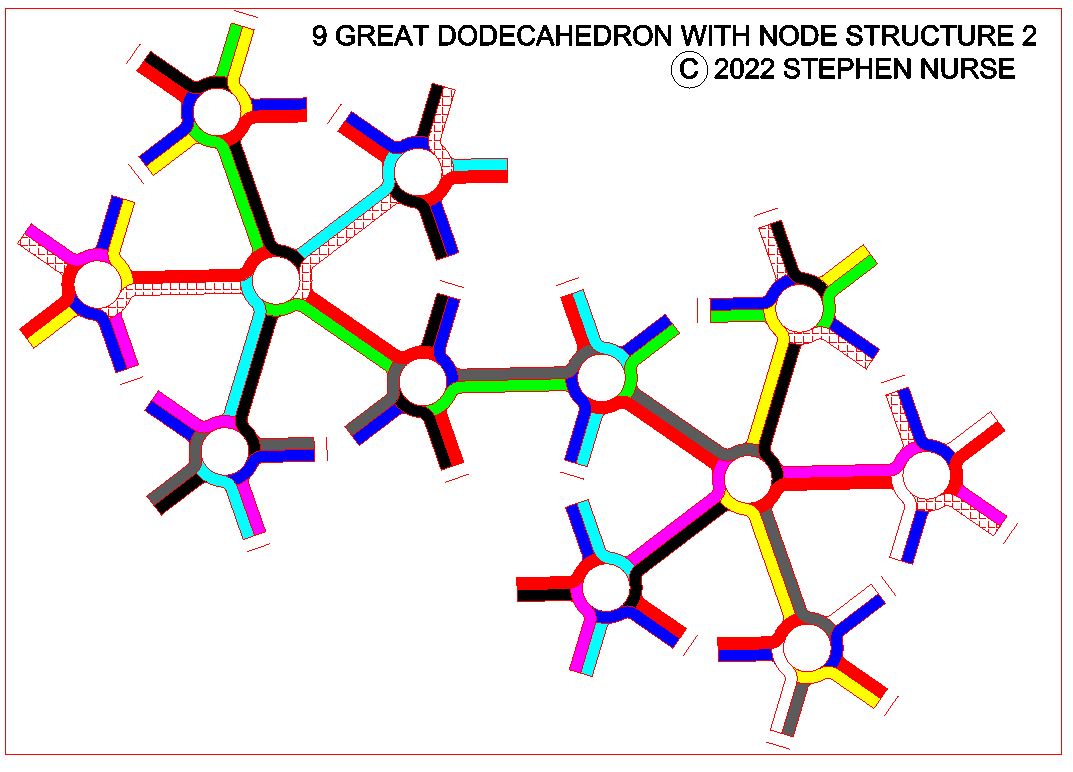
I've made a few edge net models from laminated paper (ie figs 5, 8, 14 here ) , and I thought I recognized an unusual polyhedron - the great dodecahedron - in the icosahedron model I'd made. (see this post also, I have drawn a great dodecaheron in 3d so knew what one was). 

Then I saw another polyhedron that was new to me in what I'd already made, and I couldn't name it at the time. But on this page, fig 9 , and on this page, (figs 7 and 8 left) are versions of a skeletal octahedron, a polyhedron which in its pure, mathematical form has no volume. At that stage, I decided to map some of the work I've done, roughly as follows:

So the table goes through the platonic solids with rows corresponding to the number of edges meeting at nodes. Columns correspond to the turns that edge halves make as they go through the nodes. In the first column, edges join to form simple polygon faces. Intervening columns have overlap of faces. Lastly when the edges turn right around in the node, edges can merge. It should be possible to make all these forms in basket cane, and previous examples are figure 5 here (equivalent to figure 2 below), and figure 9 here, which is the skeletal octahedron.

3d printed great dodecahedron and skeletal octahedron


Made up models, top to bottom skeletal octahedron, great dodecahedron, tetrahedron.


Most of the rest of this post is the figures described in the table without too much wordage. Some of these have been posted before, but more or less as isolated things, and this is the first time I've placed them in context. This post is a "sketch", not an exhaustive "picture" so I hope you can work out what's going on.

Figure 1 shows an angle which corresponds to the angle in the table. Figure 3 shows 2 different node structures, the interlocking nodes can be put together 2 ways (see also figure 4) and the overlapping nodes 6 ways (or n!  / n factorial where n is the number of edges joining at the node). Figure 3 has a form that is slightly cheating, the tetrahedron is made up of sides defined by different-coloured edges, whereas the others show sides defined by same-coloured edges.


A version of this post with downloadable dwg and stl (3d printable) files is at https://www.thingiverse.com/thing:5427703 .

The octahedron and icosahedron sequences are nice!


Update Feb 2, 2023: I've put together an article on these structures, click this link to download.