News and Events

Keep up to date with Steve Nurse's designs and 3d printing.

Wednesday, 19 April 2023

Foiling Surfboards and Alt Surf

 Hi

 This is an article which originally appeared in the June 2021 issue of Huff,  the magazine of OzHPV inc. which I write for and edit. So this article went out to subscribers only, but I thought I would drag it out for all to see. Since it was written, the term Alt Surf has been coined for some of the different craft described below. So - um - please enjoy my writing from a few years ago. It has fairly basic layout at the moment and I will go in later and see if I can improve things.

Regards


Steve Nurse


Caspar Steinfath

Earlier this year, Casper Steinfath piloted a paddled foiling watercraft successfully across 120k of sea between Denmark and Sweden. Foiling is a bit like flying, with an underwater wing lifting most of a watercraft into the air, and away from the surface of the water. It marks an achievement for this type of craft and its pilot, and I decided to try to do an explainer for Huff.

 Caspar’s achievement came to my attention through a surfing website, Magic Seaweed. Although mainly to do with surfing and surf forecasts, surf sites like Seaweed cover all sorts of craft that make their way into the waves.  


Surfing itself started as a hybrid of arm paddling and wind energy. Wind conditions at sea give rise to ocean waves, and they are an accumulation of offshore weather. But these days many combinations of human, natural and machine energy count as surfing. There are stand-up paddle boards, wave pools with machine generated waves, foiling surfboards, kitesurfers, wingsurfers, windsurfers, electric surfboards, and surfboards towed into waves by jetskis. Foiling is quite a small part, but when famous surfers go foiling it is reported, videoed and seen, for example this video of surfing champion John-John Florence foiling as if by magic. The foils are supported on undersea currents, and sometimes these are parts of unbroken and invisible waves out at sea.


Alan Abbott prone / head forward streamliner.


Alec Brooke recumbent streamliner


Human powered foiling started in 1983, when some the first human powered hydrofoils were built and ridden by Alan Abbott and Alec Brooks.  A few years earlier, Bradham Brewster had researched and written about the possibility of the hydrofoils in a mechanical engineering thesis , and Abbott and Brooks took up the challenge of building a foiling watercraft. All had been involved with one of the fathers of the modern human powered vehicle movement, David Gordon Wilson, and Abbott and Brooks had both built streamliners for human powered land speed competitions. Alan Abbott also piloted record breaking bicycles which were ridden in the slipstream of cars.

Flying Fish 1

 
Flying Fish 2

Research into human powered hydrofoils was initially done by towing the submerged wings that would provide lift, allowing the powering propulsion and the underwater wings to be developed separately. Abbott and Brook’s first hydrofoil, Flying Fish 1 didn’t float, while their 2nd, Flying Fish 2 floated on catamaran pontoons. The website for Abbott and Brook’s machines is http://flyingfishhydrofoil.com/ while http://human-powered-hydrofoils.com/ shows some machines that have been developed since. Commercial human powered hydrofoils have been slow to come, and some of the first were driven by pumping the legs up and down. An example is the Aquaskipper which was for sale on Amazon. The Manta5 from New Zealand is a current ebike hydrofoil which costs around $9000 and brings the effort of human powered foiling down a notch or two. And solar powered hydrofoiling is now a sport, with the Netherland’s TU Delft (who also have a speedbike team) competing.


Aquaskipper foiling craft

, 

Solar Electric Foiling craft
 

 Laird Hamilton pioneered the surfing version of hydrofoiling which was introduced in the 2003 film Set Into Liquid. A group of surfers, waterskiers, windsurfers and sailors developed the sport from a range of equipment. In this history of surfing hydrofoiling, the human powered versions of hydrofoils don’t even rate a mention, but having access to waterski foils from Airchair seems to have been a key step.


Manta 5


Manta 5 information showing power requirements for foiling: human and electric power


Hydrofoil surfboards now seem to be the most popular form of human powered hydrofoiling. The natural power elements can be wind from kites or handheld sails or ocean waves or currents. The human powered component can be stand-up paddling or a similar pumping technique to the Aquaskipper. But unlike the Aquaskipper, the newer surfboard hydrofoils follow the templates of surfboards and windsurfers, so aren’t seen as clunky machines. It looks like they’re here to stay, and the machines are modular with different foils, boards, paddles, inflatable wings, sails and kites going together to make a full kit.

Wingfoiling. photo courtesy Sailing World


This article really only skims the surface of the topic, but the area seemed too interesting not to mention. We’d love to hear more from Huff readers.


Saturday, 25 March 2023

More Makittoy


 Hi

For a while I have been experimenting with the Makit construction set (with posts here, and here, ) and now I'm happy to provide some more information on it.  

Firstly, in the pics above, I've made some visual representations of the 2 compatible principles governing the lengths of Makittoy rods, as described in Pic 1.

Secondly, I've scanned the makittoy documentation I have and the full (yes battered!) version is now available here. Happy Makitting!


 One of the features of Makittoy is that is has 2 rod diameters which are colour coded. Brown rods are slit at the ends which creates a little spring - they stick into the wheels or joiners which have holes which are all the same diameter. Red rods have a slightly smaller diameter and normally slide or spin in the joiner holes. There is another option with the red rods and that is to use a steel bushing with them - that turns the sliding fit into a press fit so that the joiners can also be stuck fast to the red rod. 

The Makit rods aren't elaborately transformed but are at least mildly processed - one is painted red and the other has slits in the end - so it takes at least some effort to "forge" the Makit parts, even if you start with the right diameter rod.  

In engineering terms the Makit system is Hole Basis , with fixed hole sizes and variable shafts. In a set of parts I designed recently (here)  , the fit is shaft based with a constant diameter shaft used.


Tuesday, 21 March 2023

Eddie's Knitting Machine


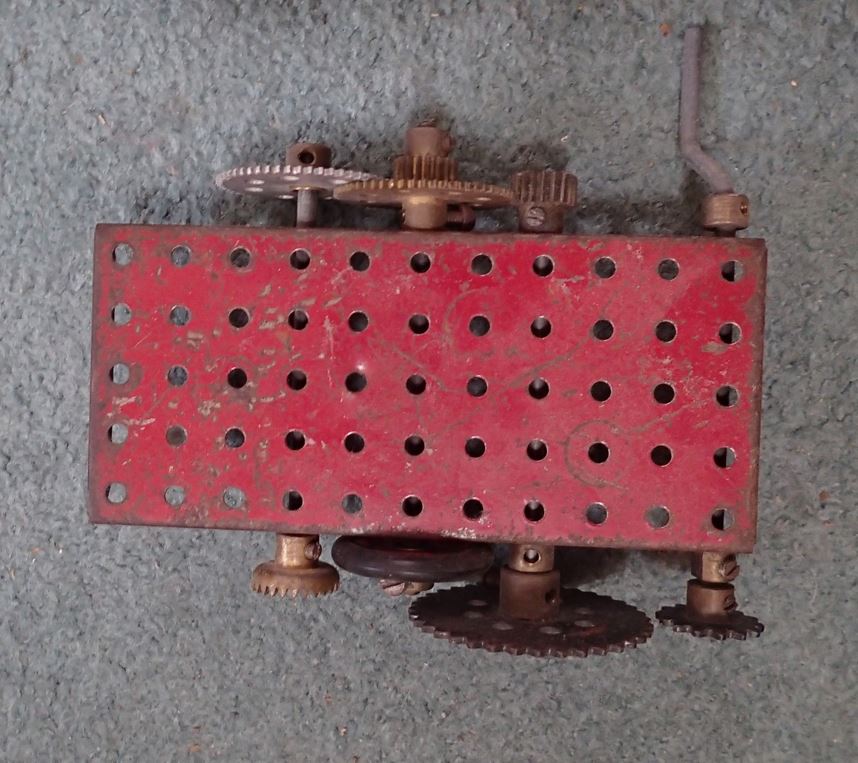
A Meccano gearing sampler which I showed to students at my son's school in about 2002 - potential knitting machine spares

Some of Eddie's Meccano

More Meccano ("Eddie's") and Meccano knockoffs ("mine")

Mary, 2023

Knitting machine before cleaning, 2023

Knitting machine with Audax riders Alex McNee and Rodney Cruz, Cobram Hotel, 2023


Christine Durbridge, Melbourne, 2023

Mary, Christine, Geoff, 2015

Knitting machine, Cobram, 2015

Christine Nurse and Steve, 2015

Knitting machine, Melbourne, 2023. The bearing circled in red is worn as detailed below.

Bearing detail. It is a steel meccano rod in a bronze bracket, and the bronze has worn so the hole is about 1mm oversize. This has happened in a few places, and the brackets are loose on the baseboard as well.

Artwork by Eddie. It is from a hand-wound machine - the closest thing we have today is Spirograph.


 When I was very young, maybe 8 or 10 or so in the late 1960's, my family used to visit my great uncle (Dad's dad's brother) Eddie in Heathmont. Eddie was an inventor and chief amongst the inventions I remember was a "Spirograph" type machine, that is a mathematics - based drawing machine. 

Spirograph has the artist moving cogs around pinned cogs to create patterns, however Eddie's machine was self contained with pattern variations programmed into the machine. The user just had to turn a handle and a pattern was created. 

Another invention was a reflecting fireplace with a small central grate and reflective surrounds, and yet another was a solar energy collector which sloped down from the back wall of the house. Lastly, Eddie had made a water clock which now resides in the Melbourne Museum.  

Eddie used everyday materials in his construction and this included Meccano. Somehow, I inherited some of Eddie's Meccano, and some of his tinkering and mechanical improvisation skills. The Meccano (a mix of Eddie's and mine) has sat idle on the top of a bookshelf for many years. But about 20 years ago I made toys demonstrating mechanical principles, and taught my son's primary school using them.

Really I had better stop rambling and get to the point! About 8 years ago, my wife Christine and I visited Moama for a holiday and drove on to Barooga during our stay, to visit my Aunt Mary (Eddie's daughter) and her husband Geoff. Time marches on, and now both Geoff and Christine are dead, Geoff dying in 2020, and Christine on October 9 2022. During that visit, Mary showed off her Dad's knitting machine - something I had never heard of - and I filmed it for youtube , photographed it, and put the results in a blog post.

Fast forward 8 years, and I was prompted by a facebook call to ride recumbents in a Cobram / Barooga Audax ride, a desire to visit my Aunt Mary again, and an email about the knitting machine video from Hilly Jacklin, a knitting machine enthusiast from the USA. 

When I visited Cobram a few weeks later, I asked Mary if I could have the machine, and she readily agreed. We retrieved it from the top of a wardrobe. A few days later I had returned to Melbourne, cleaned it up, made a jig to carry it safely and shown it to my knitting friend Christine Durbridge.

Its now my ambition to get Eddie's knitting machine working again but there is no way I can do all the work myself. As per the photos, ideally the machine should be thoroughly cleaned and restored (bearing clearances reset) before attempting use, and I do not have the basic knitting knowledge to get the thing started. 

I believe there'd have to be some sort of rod suspended above the machine onto which the knitting would be cast and then drawn upwards. Anyway, I'm putting it out there to a few contacts to see if I can get the restoration and reanimation started. Wish me luck!


Thursday, 16 March 2023

Off-Piste with Makit toy

1

2

3

4


Hi

A few weeks ago, mucking around with golf ball structures got me interested in an old construction set I had called Makittoy, and I tried and failed in finding the set I had as a kid at my parents' house.

Undaunted and unphased by this, I just went out and bought some, firstly through ebay, secondly through facebook marketplace from Tasmania. But my best set sofar was picked up from Elwood last Tuesday morning. 

I've now had enough time to make some stuff. The cube (4) could be made with the cardboard triangles supplied with the kit, but I made my own by 2d cad drawing, printing, laminating (3) then cutting out.

Also the Makittoy rods (brown / 6.42mm) could be made with DIY, they are, after all just cleft sticks - or rods with a bisecting cut at the ends - which form a very simple spring.  The spring can act in 2 ways, that is

* With thin material slid into the saw cut, the spring opens and clamps. 

* When the end is pressed into a round hole, the spring compresses and clamps.

I've since bought some 6mm and 9.5mm dowel from a local store in easy biking distance. The dowel is made locally also, see here. Will report back when I make some more things.