Hi
This is an article which originally appeared in the June 2021 issue of Huff, the magazine of OzHPV inc. which I write for and edit. So this article went out to subscribers only, but I thought I would drag it out for all to see. Since it was written, the term Alt Surf has been coined for some of the different craft described below. So - um - please enjoy my writing from a few years ago. It has fairly basic layout at the moment and I will go in later and see if I can improve things.
Regards
Steve Nurse
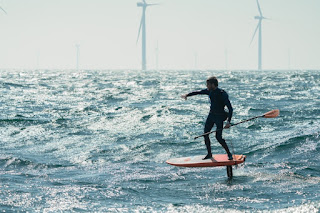 |
Caspar Steinfath
|
Earlier
this year, Casper Steinfath piloted a paddled foiling watercraft successfully across
120k of sea between Denmark and Sweden. Foiling is a bit like flying, with an
underwater wing lifting most of a watercraft into the air, and away from the
surface of the water. It marks an achievement for this type of craft and its
pilot, and I decided to try to do an explainer for Huff.
Caspar’s
achievement came to my attention through a surfing website, Magic Seaweed.
Although mainly to do with surfing and surf forecasts, surf sites like Seaweed
cover all sorts of craft that make their way into the waves.
Surfing
itself started as a hybrid of arm paddling and wind energy. Wind conditions at
sea give rise to ocean waves, and they are an accumulation of offshore weather.
But these days many combinations of human, natural and machine energy count as
surfing. There are stand-up paddle boards, wave pools with machine generated
waves, foiling surfboards, kitesurfers, wingsurfers, windsurfers, electric
surfboards, and surfboards towed into waves by jetskis. Foiling is quite a
small part, but when famous surfers go foiling it is reported, videoed and
seen, for example this
video of surfing champion John-John Florence foiling as if by magic. The
foils are supported on undersea currents, and sometimes these are parts of unbroken
and invisible waves out at sea.
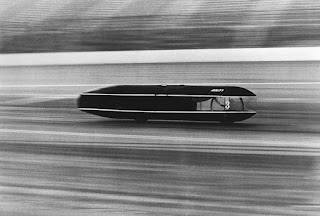 |
| Alan
Abbott prone / head forward streamliner. |
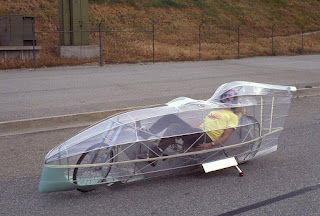 |
| Alec Brooke recumbent streamliner |
Human
powered foiling started in 1983, when some the first human powered hydrofoils
were built and ridden by Alan Abbott and Alec Brooks. A few years earlier, Bradham Brewster had researched
and written about the possibility of the hydrofoils in a mechanical engineering thesis
, and Abbott and Brooks took up the challenge of building a foiling watercraft.
All had been involved with one of the fathers of the modern human powered
vehicle movement, David Gordon Wilson, and Abbott and Brooks had both built
streamliners for human powered land speed competitions. Alan Abbott also
piloted record breaking bicycles which were ridden in the slipstream of cars.
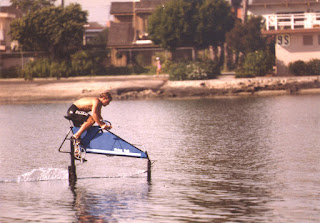 |
Flying Fish 1
|
 |
Flying Fish 2
|
Research
into human powered hydrofoils was initially done by towing the submerged wings
that would provide lift, allowing the powering propulsion and the underwater wings
to be developed separately. Abbott and Brook’s first hydrofoil, Flying Fish 1
didn’t float, while their 2nd, Flying Fish 2 floated on catamaran
pontoons. The website for Abbott and Brook’s machines is http://flyingfishhydrofoil.com/
while http://human-powered-hydrofoils.com/
shows some machines that have been developed since. Commercial human powered
hydrofoils have been slow to come, and some of the first were driven by pumping
the legs up and down. An example is the Aquaskipper
which was for sale on Amazon. The Manta5 from
New Zealand is a current ebike hydrofoil which costs around $9000 and brings
the effort of human powered foiling down a notch or two. And solar powered hydrofoiling
is now a sport, with the Netherland’s TU Delft (who also have a speedbike team)
competing.
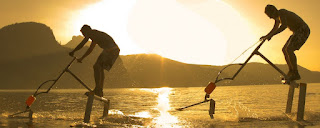 |
| Aquaskipper
foiling craft |
,
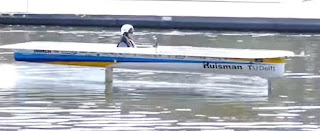 |
Solar Electric Foiling craft
|
Laird
Hamilton pioneered
the surfing version of hydrofoiling which was introduced in the 2003 film Set
Into Liquid. A group of surfers, waterskiers, windsurfers and sailors developed
the sport from a range of equipment. In this history
of surfing hydrofoiling, the human powered versions of hydrofoils don’t
even rate a mention, but having access to waterski foils from Airchair seems to have been a key
step.
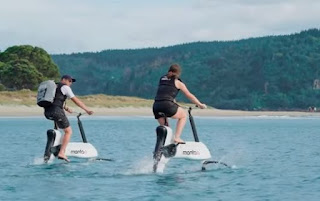 |
Manta 5
|
Manta 5 information showing power requirements for foiling: human and electric power
Hydrofoil
surfboards now seem to be the most popular form of human powered hydrofoiling. The
natural power elements can be wind from kites or handheld sails or ocean waves
or currents. The human powered component can be stand-up paddling or a similar
pumping technique to the Aquaskipper. But unlike the Aquaskipper, the newer surfboard
hydrofoils follow the templates of surfboards and windsurfers, so aren’t seen
as clunky machines. It looks like they’re here to stay, and the machines are
modular with different foils, boards, paddles, inflatable wings, sails and
kites going together to make a full kit.
This
article really only skims the surface of the topic, but the area seemed too
interesting not to mention. We’d love to hear more from Huff readers.


 Posts
Posts

